
How herbal medicines are manufactured
Phytochemicals – the foundation of pharmacology
Humans have had a close affinity with plants and plant medicine for eons of time.
Using a whole plant, the entirety of a medicinal herb, is good practice. Blending herbs tends to give them a synergy with each other, where the therapeutic effect is often “greater than the sum of the parts”.
This clinic works with Western Herbal Medicine (WHM), we have a wide range of herbs available in our inventory of available herbs, our Materica Medica. Traditional Chinese Medicine (TCM) has a huge range of herbs, some of which are also available to WHM.
In TCM, whole herbs are stored dry, to be boiled at home to make a decoction (a liquid extract) for drinking. Western Herbalists use fluid extracts, capsules of powdered herbs, and tablets.
Fluid extracts are liquids containing all the active principles stripped from the plant by a solvent, leaving the cellulose, stems and husks.
After assaying for potency the dried herb is milled fine and placed in a percolating column which is filled with solvent.
The solvent is an ethanol/water blend. Any particular herb has constituents which are alcohol soluble such as alkaloids, terpenes and essential oils. It also has water soluble fractions such as tannins, alkaloids, flavonoids, mineral salts and mucilages.
The alcohol percentage is therefore tailored precisely to the particular variety of herb.
The mix in the percolating column is called the macerate. After percolation is complete the macerate is pressed out, leaving the liquid extract to be bottled and the remaining “marc” to be cleaned from the percolator.
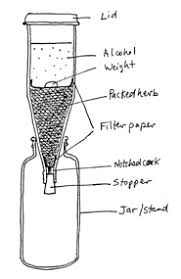
Homestyle production
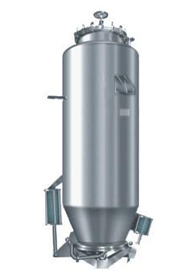
Modern industrial percolation column
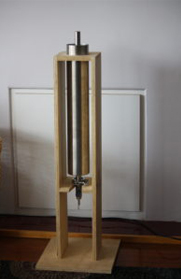
Small scale percolation column
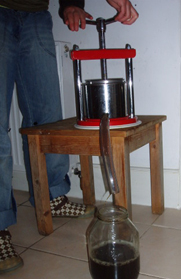
Pressing out the macerate in small scale production
Modern herbal medicine manufacture
Quality Control


Extraction & Bottling, Tablet Manufacture

